

How to tell if you have it
- Look where pipe is exposed: at the hot water tank, under sinks, in the crawl space or an unfinished basement ceiling.
- Poly-B is light grey, flexible and usually half an inch or three quarters of an inch across.
- Look for printing along the pipe. It often reads PB2110.
- Look at the fittings. Grey or white plastic fittings with metal crimp rings are the older, weaker kind. Copper or brass fittings are better.
Do not confuse it with PEX, which is the modern replacement and comes in white, red and blue, or with grey PVC drain pipe, which is rigid and much larger.
Why it fails
- Plastic fittings crack, especially where they were over-crimped
- The pipe wall becomes brittle from the inside with long exposure to chlorinated hot water
- Pipe run close to the hot water tank or installed under strain fails first
- Failures are sudden: a split or a popped fitting, not a slow drip
Plenty of Poly-B systems are still working. The difficulty is that you cannot judge the inside of the pipe from the outside, and age works against it.
What insurers do about it
Practice differs from one insurer to the next and changes over time, so treat this as a list of questions to ask and not as a statement of your cover. Homeowners with Poly-B commonly report one or more of the following: a higher premium, a higher deductible for water damage, a limit on water damage cover, a request for a plumber's inspection, or a deadline to replace it. Some insurers will not write a new policy on a house with Poly-B.
- Ask your broker directly whether your policy has any condition or exclusion for polybutylene.
- Answer the question honestly on any application. A wrong answer can put a claim at risk.
- If you are buying, get an insurance quote on the house before your subjects come off.
- Keep any plumber's inspection report or repipe invoice. Insurers ask for them.
Your options
| Inspect and monitor | A plumber checks the visible pipe and fittings, the water pressure and the hot water tank temperature. Useful for an insurer, and a sensible first step. |
|---|---|
| Lower the stress | Keep house pressure at or under 60 psi with a working pressure reducing valve, and keep the tank at 49°C to 60°C. |
| Replace the fittings | Swapping plastic fittings for brass where they can be reached. A partial measure, and not every insurer accepts it. |
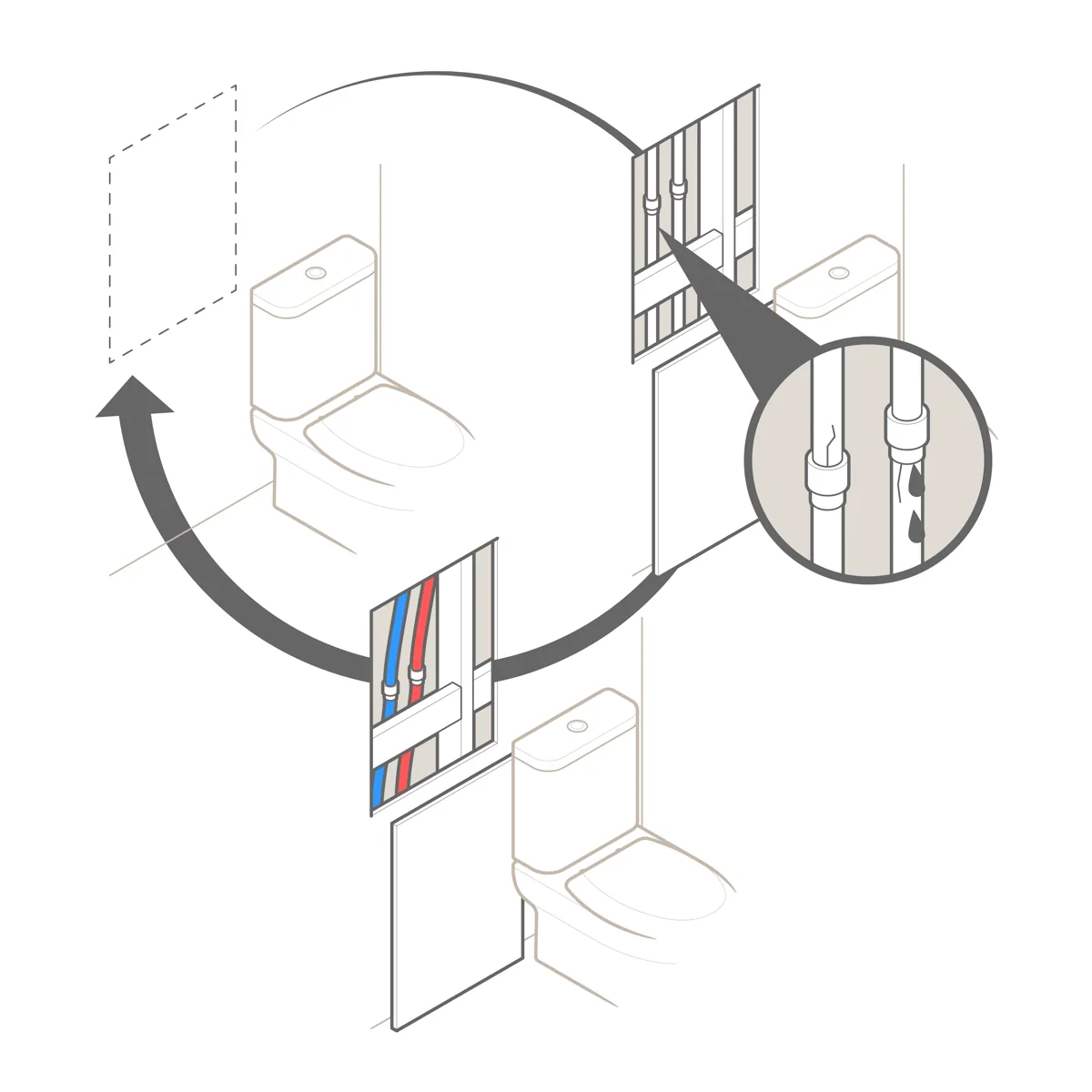
| Repipe | Replace all of it with PEX or copper. The only complete fix. Walls and ceilings are opened at intervals and patched afterward. |
What a repipe costs
It depends on the size of the house, the number of bathrooms, how many storeys, and how much of the pipe is behind finished walls. We quote repipes in writing after an on-site estimate ($269, taken off the price if you go ahead). See Poly-B repiping for how the job runs.
Ask any contractor whether their price includes drywall patching and painting, permits, and a pressure test. Those are where repipe quotes differ most.
Questions people ask
Is Poly-B illegal?
No. It is no longer accepted for new installation under current plumbing codes, but existing Poly-B does not have to be removed by law.
Does every house with Poly-B need a repipe right now?
Not necessarily. If it has copper fittings, sensible pressure and no history of leaks, monitoring may be reasonable. Your insurer's position often decides the timing.
How long does a repipe take?
A typical house takes several days for the plumbing, plus time for wall repair. Water is usually back on each evening.
I have Poly-B in my in-floor heating. Is that the same?
It is the same material in a different system, with its own failure pattern. It needs to be looked at separately from the drinking water pipes.